
Fire Suppression System in Pakistan: Types & Maintenance
Fire Suppression Systems in Pakistan: Types, Standards, and Maintenance
You've seen it in dozens of movies: a hero pulls a fire alarm, and suddenly every sprinkler on the ceiling erupts, drenching the entire building. It’s a great dramatic moment, but it’s also a complete myth. A real fire suppression system is far smarter—and less messy—than Hollywood lets on.
So, how do sprinklers actually work? In practice, each sprinkler head is a self-contained firefighter, waiting to be activated only by the intense heat of a fire directly below it. This targeted approach is a cornerstone of modern fire safety, designed to control a blaze with minimal water damage.
From the office towers in Karachi to hotels in Lahore, this guide will demystify the firefighting and protection systems technology that keeps you safe, explaining what systems protect a data center versus a kitchen, and why maintenance is critical.
How Does a Sprinkler Really Stop a Fire?
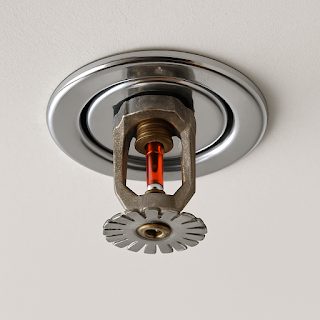
Contrary to what you’ve seen in movies, pulling a fire alarm won’t cause a building-wide downpour. Fire sprinklers are much smarter than that. Think of each sprinkler head not as a simple nozzle, but as its own heat-activated firefighter. Each one contains a tiny, heat-sensitive plug—often a small glass bulb filled with colored liquid—that acts as a lock, holding back the water.
This lock is designed to break only from the intense heat of a real fire, typically when the air around it reaches 155°F (68°C) or higher. This means that smoke from burnt toast or a foggy room won’t trigger it. Only a fire growing directly below a sprinkler head gets hot enough to burst that specific bulb, releasing a targeted spray of water directly onto the blaze.
This individual activation is incredibly effective. In fact, fire safety experts report that in over 90% of fires where sprinklers activate, only one or two heads are needed to control or extinguish the fire completely. This precision stops the fire from spreading while also minimizing water damage. But this system relies on having water ready in the pipes—so what happens in a place where that water could freeze?
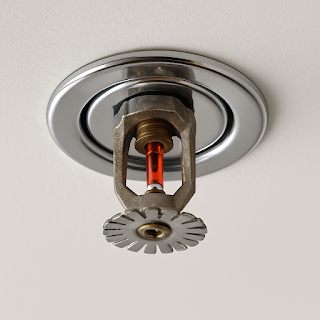
A clear, close-up photo of a single, modern fire sprinkler head installed on a plain white ceiling
Wet vs. Dry Pipe Systems: Why Location Matters
That freezing problem is exactly why not all fire sprinkler types are created equal. In most climate-controlled buildings, like offices or hotels, you’ll find a fire protection system like a wet pipe system. The name gives it away: the pipes are always filled with water, ready for immediate release the moment a single sprinkler head activates. It’s the fastest and most common type of fire suppression system.
However, for an unheated space like a parking garage or an outdoor loading dock, that water would freeze, crack the pipes, and render the system useless. For these environments, engineers use a dry pipe system. Instead of water, the pipes are filled with pressurized air or nitrogen.
When a fire breaks out and a sprinkler head bursts, the air rushes out first. This sudden drop in pressure acts as a signal, opening a main valve that allows water to flood the pipes and spray onto the fire. While there’s a slight delay, this clever adaptation ensures protection is available, even when temperatures drop well below freezing. But what if the problem isn’t the cold, but the very assets you’re trying to protect?
What If Water Is the Wrong Answer? Protecting Electronics and Archives
Dousing a server room, a hospital’s MRI machine, or a museum archive with water would cause as much damage as a fire. For these sensitive environments, a different strategy is needed for protecting server rooms from fire and other delicate assets. This is the job of clean agent systems. Instead of liquid, these systems deploy a specialized, invisible gas. The "clean" part is key: after it puts out the fire, the gas evaporates completely, leaving behind zero residue, moisture, or mess.
Rather than cooling the fire, these modern alternatives to halon gas work by attacking the fire’s chemistry. The gas quickly reduces the oxygen in the room to a level where fire can’t survive, but it's still safe for people to breathe for a short period during evacuation. Think of it as surgically removing the air a fire needs to breathe without affecting the valuable equipment. This is one of the primary fire protection equipment advantages of gaseous fire suppression.
The result is that the fire is extinguished in seconds, and critically, the multi-million dollar servers or irreplaceable historical artifacts are left completely unharmed. This specialized approach shows how fire protection is not one-size-fits-all. But just as electronics need a delicate touch, other high-risk areas like commercial kitchens and factories have their own unique dangers that require yet another set of tools.

A clean, modern server room with rows of server racks. Small, unobtrusive nozzles are visible on the ceiling, distinct from typical sprinklers
Kitchens and Factories: Fighting Fires in Special-Hazard Areas
Everyone knows you don't throw water on a grease fire; it just splashes the burning oil and makes things dangerously worse. This exact problem which is why commercial kitchen fire protection is so unique. The nozzles you see mounted in a restaurant’s exhaust hood aren't filled with water, but with a substance designed specifically for this volatile environment.
That solution is a wet chemical system. When triggered by high heat, it sprays a fine mist that instantly cools the fire and reacts with the hot grease to create a thick, soapy foam. This foam blanket smothers the flames, cutting off their oxygen supply and preventing the fire from re-igniting, providing a robust defense against one of the most common business fires.
On an even larger scale, like at an airport fuel depot, a similar principle is used in a foam suppression system. These are designed to cover huge pools of flammable liquid with a durable blanket of foam, separating the fuel from the air. But whether it's a gas, chemical, or foam system, even the most advanced design is only effective if it's ready to work, which highlights the critical role of regular maintenance.
Why a “Good” System Can Still Fail: The Critical Role of Maintenance
A fire suppression system is a silent guardian, always on duty. But like any high-stakes equipment, it’s only reliable if it's regularly checked and maintained. Installing a state-of-the-art system is just the first step; ensuring it remains ready to activate at a moment’s notice is an ongoing commitment to safety.
While professionals conduct detailed tests, anyone can spot basic warning signs. A quick visual fire suppression inspection checklist includes making sure:
- Sprinkler heads have a clear path and are not blocked by boxes or shelves.
- Pressure gauges on the system’s pipes are in the “green zone.”
- Fire alarm connections appear intact and undamaged.
These simple checks, part of official NFPA standards for fire protection, ensure the system can do its job. Whether you’re a building owner scheduling an inspection or an employee noticing an issue, proactive system maintenance is everyone’s responsibility, turning a passive device into an active defense.
Your Next Step to a Safer Space in Pakistan
The Hollywood myth of a building-wide drenching is just that—a myth. Real fire safety is intelligent and precise. The core of modern fire protection isn't one-size-fits-all; it’s about using water, gas, or chemicals with precision. Choosing the right automatic extinguisher is a calculated decision, matching the solution to the specific risk.
From an office in Karachi to a kitchen in Lahore, these systems are silent guardians. The next time you enter a building and look up, you’ll no longer see simple fixtures. You will see an intelligent layer of safety, designed to protect lives and property across Pakistan—explore fire protection products or request a complete system.